
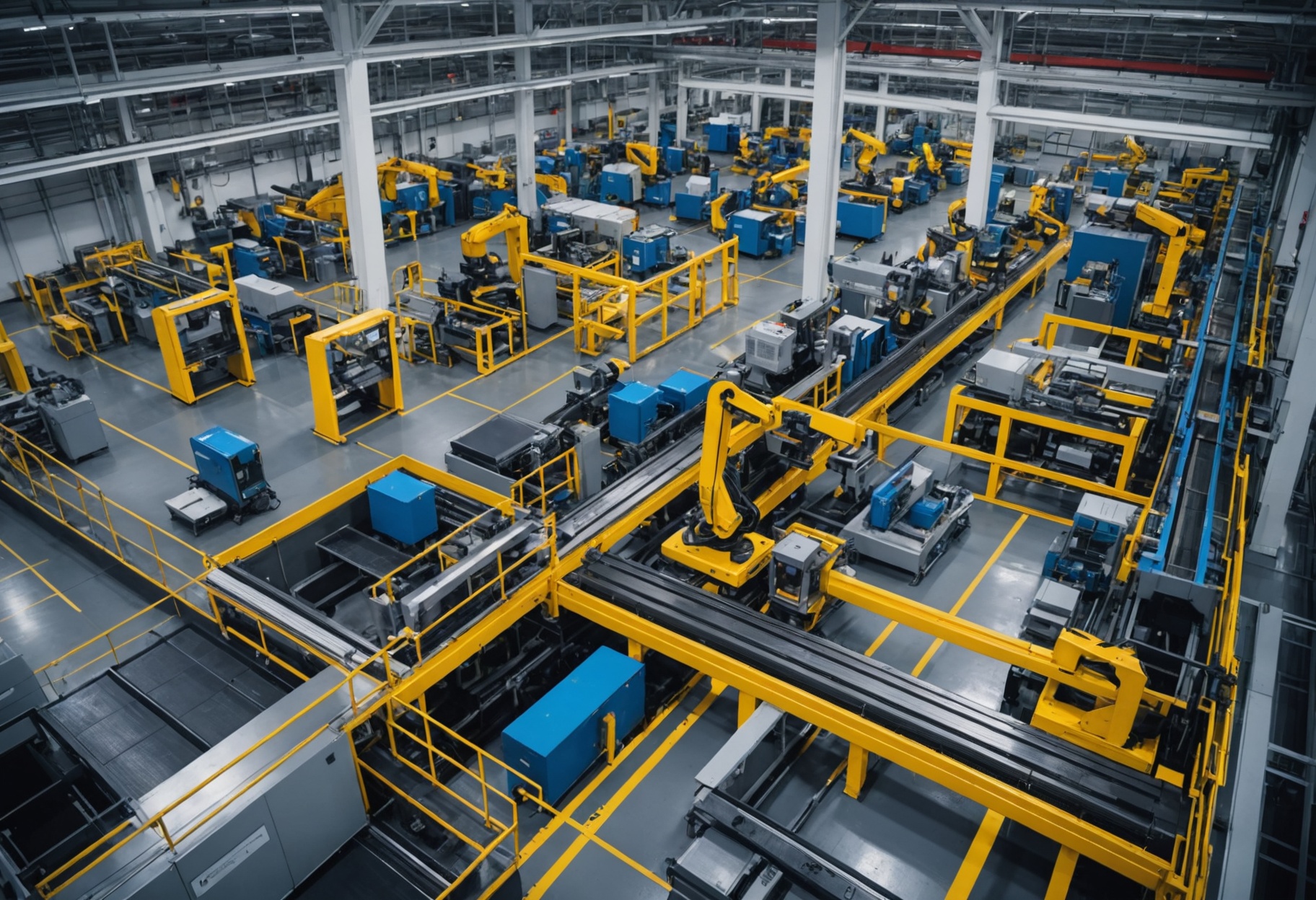
Unplanned downtime in discrete manufacturing costs an average of $260,000 per hour. We built EdgeRun because the dominant approaches to solving this problem — threshold-based alarms and manual inspection rounds — have not improved materially in thirty years. Today we're announcing a $3.2M Seed Round to move faster on the hardware and software work that still needs to happen before this changes.
What the Round Is For
The capital splits roughly 60/40 between hardware development and customer expansion. On the hardware side, our updated ER-300 edge gateway reduces unit power consumption by 34% compared to the current ER-200 series and adds onboard SIL 2 safety certification — a prerequisite for ATEX Zone 1 deployments in chemical processing plants. The ER-300 ships to pilot customers in Q2 2026.
On the customer side, we have four active pilots in automotive and process manufacturing, two of which have passed the 14-day baseline calibration window and are generating live anomaly scores. The round lets us staff a dedicated customer success function so pilots convert to multi-year contracts rather than stalling in procurement.
Why We Raised a Seed Round Now
We could have stayed lean for another eighteen months on consulting revenue from the pilot deployments. The decision to raise was driven by a specific market window: three Tier 1 automotive suppliers are mid-cycle on their CMMS replacement projects, and the integration work required to connect EdgeRun alerts to IBM Maximo as a net-new vendor is significantly easier during a CMMS migration than after. Missing that window would mean two years of competing against an entrenched incumbent integration.
Seed timing in industrial hardware is also different from software. Hardware requires a longer development cycle, and the ER-300's SIL certification process has a fixed nine-month clock regardless of how much we spend on it. Starting that process now puts certification completion in Q2 2026, aligned with when chemical plant customers can schedule installation downtime.
What EdgeRun Has Built So Far
The platform consists of three components: the edge sensor node, the edge gateway, and the cloud dashboard. Edge sensor nodes — clip-on devices that measure vibration, temperature, and acoustic emission — attach to rotating equipment without shutdown. The gateway runs a local anomaly detection model using a variational autoencoder trained on each asset's 14-day baseline signature. When the reconstruction error exceeds the calibrated threshold, the gateway sends a structured alert to the connected CMMS within 200 milliseconds.
Our current pilot data covers 94 monitored assets across four sites. Of the nine failure events that occurred during pilot operation, EdgeRun detected eight with an average advance warning time of 22 hours. The one miss was a shaft fracture caused by a dropped component — a mechanical impact event, not a degradation failure, which is outside the anomaly model's design scope.
The Market Problem We're Addressing
The industrial predictive maintenance software market has a hardware problem: the monitoring hardware deployed at most manufacturing facilities was designed for fixed-threshold alarming, not continuous waveform capture for ML inference. Retrofitting ML-based anomaly detection onto that hardware means either replacing the sensors entirely or accepting data quality that's too coarse for accurate RUL estimation.
EdgeRun's sensor node samples vibration at 25.6 kHz — fast enough to capture the characteristic defect frequencies for bearings, gears, and pump impellers. Most OEM condition monitoring systems sample at 1–4 kHz, which is adequate for detecting gross mechanical failure but insufficient for the stage-2 bearing fault signatures that show up 3–6 weeks before seizure. That sampling gap is where early detection lives.
Our Investors
The Seed Round was led by an industrial technology-focused seed fund based in New England, with participation from two angel investors with operating backgrounds in manufacturing operations and industrial automation. We chose investors with relevant domain experience because the commercial sales cycle for capital equipment in manufacturing is long and the diligence requirements are specific — investors who have been through a plant acquisition process understand what "qualified vendor" status means and why it takes twelve months to get there.
Team Update
We're hiring two roles as part of this round: a hardware firmware engineer with embedded Linux and RTOS experience, and a field applications engineer who will own pilot deployments and the technical component of the sales cycle. Both roles are based in Stamford, CT. If you have a background in industrial automation or condition monitoring and want to build something that runs in facilities where the consequences of failure are measured in production hours rather than ticket response times, reach out to info@edgerunai.com.
What Comes Next
The next twelve months are about converting pilot data into long-term customer contracts and shipping the ER-300. We'll also complete the OPC-UA server integration that lets EdgeRun push asset health scores directly into Siemens WinCC and Rockwell FactoryTalk displays, rather than routing through the CMMS. Operators who already know where to look for equipment health data shouldn't need to open a new application to see what EdgeRun is reporting.
We'll publish quarterly technical updates on what we're learning from production deployments — not marketing summaries, but the actual signal processing and model tuning observations that come from running sensors on real equipment for months at a time. The predictive maintenance field has a shortage of candid field reports. We intend to fill some of that gap.
Follow the platform's development
Request a technical demo to see live anomaly scores from a current pilot deployment.
Request a Demo